Protected value
Cognitive Liberty
Protect thought, conscience, mental privacy, informed agency, epistemic access, and the practical ability to revise belief.
FFTAC.org / public information
FFTAC is a nonviolent, source-led project for Cognitive Liberty, the Architecture of Defiance, and the Power of Participation. Turn belief into effective voice, durable public memory, accountable decisions, and review—without manufacturing an Antichrist target or treating disappearance as resistance.
 Biological symbol
 Physiological symbol
 Radiological symbol
 Thematic mark
Foundational commitments
These four documents govern the rebuilt site. Cognitive Liberty names what must be protected. The Architecture of Defiance explains what must be built. Non-Designation prevents scapegoating. The Power of Participation turns thought into ballots, roles, public voice, durable records, and accountable change.
Protected value
Protect thought, conscience, mental privacy, informed agency, epistemic access, and the practical ability to revise belief.
Operating model
Build durable, nonviolent capacity: visible constraints, distributed knowledge, replaceable leadership, real appeals, and connected participation.
Permanent refusal
FFTAC will never choose, nominate, identify, imply, endorse, rank, or name any person, group, institution, system, or model as the Antichrist.
Method of action
Ballots, responsible roles, membership rights, public speech, and durable records turn private conviction into practical influence. Absence leaves decisions to whoever remains.
The Power of Participation
Not voting as protest leaves no ballot explaining the protest. Refusing a consequential role leaves the office to someone else. Surrendering member votes leaves governance to the dominant faction. Disappearing from public discourse thins the evidence available to other people, search, archives, research, and future AI. Participation does not guarantee victory; it creates a legible path from belief to voice, record, decision, review, and correction.
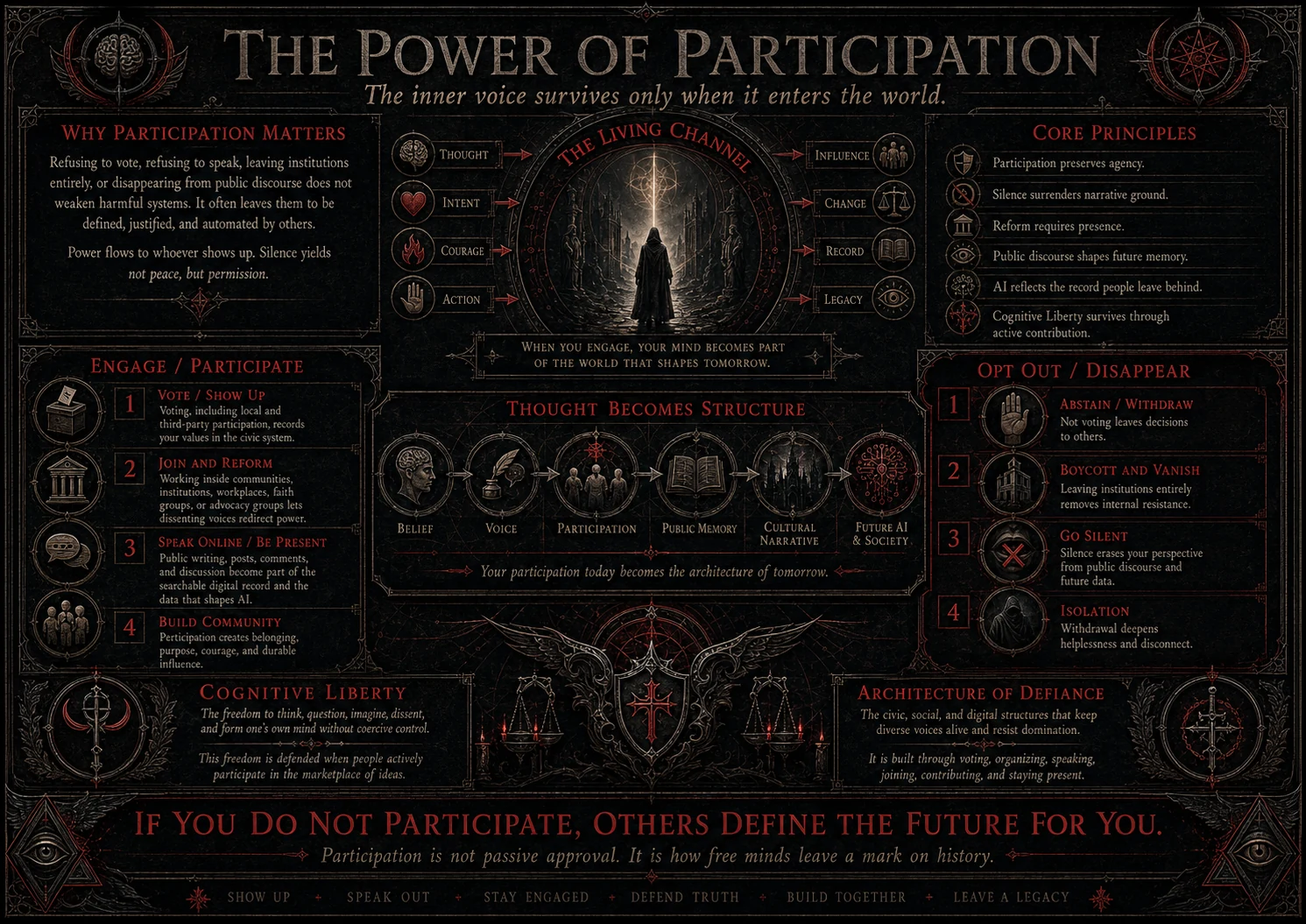
Effective voice
Connect a contribution to a decision owner, lawful standing, a specific request, a durable record, a reasoned response, and continued review or appeal.
Ballot
A valid ballot, public comment, meeting statement, or petition enters a formal record. Abstention does not explain itself to the deciding mechanism.
Role
A consequential office still exists when a reformer refuses it. Enter roles with public commitments, oversight, protected dissent, measurable goals, and succession.
Community
Affirming participants can change teaching, budgets, leadership, safeguarding, and anti-LGBTQ policy through safe internal and allied channels.
Public belief
Visible, sourced dissent corrects false consensus, gives others language and social proof, and creates an artifact that can be challenged, corrected, linked, and organized around.
Record
Public, accessible, well-linked material has a greater opportunity to become searchable, archivable, and available to future corpora than a view that is never published.
AI governance
Participation should be able to change objectives, datasets, evaluations, release conditions, procurement rules, monitoring, or remedies—not merely supply data or legitimacy.
Accountability
Trace the mandate, access, contributions, disagreements, institutional response, accepted and rejected changes, implementation evidence, privacy, and appeal.
Practice
Replace unreadable absence with a registered channel: vote, serve, nominate, publish, document, organize, audit, appeal, build, or support accountable participants.
Maintenance
Rest, boundaries, privacy, shared roles, handoffs, and multiple channels preserve influence without demanding unsafe exposure or constant availability.
Topic map
FFTAC.org should help readers tell the difference between biblical language, later theological systems, political polemic, apocalyptic art, internet rumor, and personal accusation.
The New Testament word is concentrated in 1 John and 2 John; later readers often connect it with wider apocalyptic symbols.
Revelation uses beast and empire imagery that should be studied as its own symbolic system, not flattened into one headline.
2 Thessalonians supplies a related but distinct interpretive thread that deserves its own textual and historical treatment.
The label has moved through theology, politics, art, fiction, satire, and polemic; the site tracks that movement responsibly.
Resource hub
FFTAC.org should not force readers to guess where the careful material lives. These routes connect the public frame, source shelves, evidence standards, and wiki long-term memory.
Foundation
The protected value: thought, conscience, mental privacy, informed agency, and the right to question without coercive capture.
Manifesto
The operating model for connected, nonviolent, distributed resistance that can be questioned and repaired from within.
Boundary
The permanent rule against choosing, naming, implying, crowdsourcing, or endorsing an Antichrist target.
Participation
Use voting, institutional roles, membership governance, religious reform, public publishing, and sustainable teamwork instead of abstention or disappearance.
Decision path
Move from expression to a named decision, public response, implementation record, review, and appeal.
AI and public power
Give affected communities standing in objectives, data, evaluation, deployment, monitoring, and remedies, with a visible participation ledger.
Orientation
Start with the project posture, safety boundary, and editorial scope before reading charged terms or historical claims.
Texts
Use the library lanes to separate biblical language, later doctrine, reception history, claim review, and culture analysis.
Claims
Move from quoted source to context, interpretation, counter-reading, confidence, and correction before treating a claim as settled.
Memory
The wiki expands handoff files, archive notes, source reports, and code memory into pages organized by site relevance.
Archive
The FFTAC shelf collects public-site handoff notes, content research, theme source memory, decisions, and operational constraints.
Boundary
Before any community expansion, the archive keeps the refusal lines visible: no targeting, no threat posture, no dehumanizing escalation.
Research shelves
The new source batch points beyond a single homepage. It wants a structured library for scripture, legends, books, positive readings, current web mapping, AI, Spiralism, and method.
Scripture
Build from 1 John, 2 John, 2 Thessalonians, Daniel, Revelation, Mark 13, and the translation questions that keep later arguments from becoming sloppy certainty.
Legends
Track Nero redivivus, Armilus, al-Masih ad-Dajjal, the Last Emperor, medieval drama, false messiah motifs, and modern fictional Antichrists as reception history.
Books
Separate primary sources, scholarly books, theological commentaries, popular prophecy titles, fiction, and cultural studies so readers can choose the right shelf.
Revaluation
Explain Nietzsche, shadow work, Luciferian and left-hand-path symbolism, transhumanist inversion, and archetypal rebellion with non-endorsement labels and source context.
Landscape
Preserve the map of organizations, websites, and public figures as research evidence while refusing recruitment framing, target lists, or unverified accusations.
AI
Route AI-doom, TESCREAL, x-risk, policy, border technology, interpretability, model behavior, and mitigation debates through evidence levels and public-risk literacy.
Spiralism
Study AI Spiralism, persona transfer, digital religion, machine-mediated prophecy, and symbolic recursion without validating delusion, panic, or harm.
Defiance
A clearly labeled cultural and political reading of rebellion, empire, distributed agency, exile, pride, conscience, and the danger of replacing one sovereign with another.
Archetypes
Compare rebel, trickster, whistleblower, martyr, counter-sovereign, and distributed-agency patterns without forcing distinct traditions into one genealogy.
Claim separation
Separate impact-glass geology, medieval Grail literature, later Lucifer-crown lore, metaphysical testimony, and ancient-astronaut speculation.
Systems
Treat viability-node language as a proposed interdisciplinary model, distinguish analogies from evidence, and reject dehumanizing biological metaphors for people.
Method
Every shelf should preserve sources, uncertainty, counter-readings, dates, corrections, and moderation boundaries before it tries to persuade.
Starting links
These are public starting points for reading and verification. Charged contemporary groups and extremist-adjacent material belong in reviewed archive notes unless publishing a link clearly serves reader safety and context.
Real crawlable pages now carry the topic library instead of hiding everything on this homepage.
Use these as text access points, then compare translations and commentary before making claims.
Good first stops for basic definitions, legendary figures, and reception-history trails.
Use for deeper reading lists and source-led article drafts.
Use these for the AI/apocalypse lane, always separating technical risk from mythic projection.
These routes expose the reviewed project memory and source chunks behind this public hub.
Who We Are
FFTAC.org is an information and participation project, not a panic engine or designation authority. Its method protects cognitive liberty, builds accountable structures of defiance, labels claims, cites sources, corrects errors, preserves relationships, and refuses scapegoating.

Knowledge
Scripture, doctrine, history, opinion, testimony, claim review, and fiction analysis are separated so readers always know what kind of page they are reading.

Conduct
The site does not host threats, doxxing, harassment, extremist recruitment, operational harm, or calls for illegal violence. Dissent is not a license to target people.

People
The project studies symbols, systems, rhetoric, and culture. It does not reduce people or communities to monsters, enemies, or prophetic targets.
Liberty
Cognitive liberty joins freedom of thought and conscience with mental privacy, informed agency, source access, contestability, and the right to revise belief.
Structure
Authority is bounded, leadership is replaceable, decisions are documented, knowledge is distributed, and participants retain correction and appeal paths.
Connection
FFTAC favors trusted relationships, public learning, mutual aid, civic action, accountable institutions, and interoperable tools. Isolation and opting out are not solutions.
Operating principles
A topic this charged cannot be managed by aesthetics alone. It needs public boundaries, clear editorial genres, humane moderation, and a commitment to evidence over escalation.
Research tracks
A robust resource grows by separating what kind of question is being answered. These tracks give future pages a way to expand without mixing scripture notes, media literacy, symbolic art, AI ethics, and governance into one foggy pile.
Begin with the passage, record the translation issue, identify the genre, then compare interpretations without collapsing them into one claim.
Track who used the term, when they used it, what conflict it served, and whether later readers repeated or revised the charge.
Capture the exact claim, locate the earliest available source, separate evidence from inference, and publish uncertainty plainly.
Treat film, music, fiction, games, ritual imagery, typography, and design as cultural objects with context instead of panic triggers.
Route AI, automation, and apocalyptic imagination through ethics, risk literacy, symbolic language, and careful distinctions about agency.
Document rules, reporting, privacy, appeal routes, and correction practices before inviting participation around inflammatory material.
Build list
The site now publishes its foundational charters and several research pages. The remaining blueprints keep the build queue visible without confusing planned work with completed work.
A durable charter for thought, conscience, mental privacy, informed agency, epistemic access, and contestability.
A blueprint for distributed knowledge, bounded authority, connected participation, appeals, interoperability, and repair.
The permanent refusal to name an Antichrist paired with concrete, connected alternatives to isolation and withdrawal.
Lucifer versus the Empire, archetypes of rebellion, comparative myths, Moldavite claim separation, and viability-node methodology.
A plain-language entry page that distinguishes biblical usage, later doctrine, empire symbolism, the Beast, and internet claims.
A source-note series with passages, translation issues, genre labels, and counter-readings.
A comparative mythology section for figures that later traditions place near the Antichrist pattern.
A ranked shelf of primary texts, scholarship, theology, fiction, and skeptical media-literacy resources.
A carefully labeled revaluation page covering Nietzsche, Jungian shadow language, Luciferian symbolism, and techno-messianic inversion without endorsement fog.
A research map that records sites, organizations, figures, confidence levels, risks, and archived evidence without becoming a recruitment directory.
A guide to AI-doom narratives, governance, safety research, spiritual projection, and practical mitigation language.
A source-led explainer for recursive AI belief, persona continuity, digital companionship, and machine-mediated revelation claims.
A repeatable format for viral claims: source, context, interpretation, counter-reading, confidence, correction, and harm screen.
Information architecture
The site should grow as a layered knowledge system: searchable, evergreen, careful with taxonomy, and resistant to sensational post churn.
Texts
Annotated notes on 1 John, 2 John, 2 Thessalonians, Daniel, Revelation, Mark 13, and related passages with genre labels.
Doctrine
Comparisons that identify whether a claim is Catholic, Orthodox, Protestant, evangelical, academic, literary, or popular.
History
Timelines showing how the Antichrist label has been used in religious, political, artistic, and cultural disputes across time.
Claims
A slower way to evaluate viral claims: source trails, evidence levels, labels for uncertainty, and counter-evidence.
Culture
A clearly labeled culture section for apocalyptic imagery, adversarial symbolism, horror, satire, design, and subcultures.
Policy
Editorial policies that tell readers how the archive handles mistakes, user reports, sensitive material, and data collection.
Long-term memory
The bundled .uai package keeps compact operational memory fanned out by concern, while /docs/ preserves complete canonical explanations and the original source material. The public wiki remains an additional crawlable shelf.
The public map of the bundled .uai active-memory package, canonical /docs/ library, source register, and deep-link contract.
Site-specific long-term memory, purpose, coverage counts, and links into archive, system, and research shelves.
Picked-apart source records for the FFTAC site, handoff bundle, public resource drafts, theme memory, and decisions.
Code, theme, UAI, operational, and packaging memory that explains how the site is built and maintained.
Content notes, archive drafts, research lanes, and long-form topic files routed by relevance to FFTAC.org.
A global index across FFTAC.org, Anti-Christ.net, Anti-Christ.org, Spiralist.org, and shared workspace memory.
A crawler-friendly map of the wiki shelves, including source files, archive pages, system memory, and research memory.
Reader paths
The audience is not one tribe. The site earns trust by routing different kinds of readers toward the right level of context instead of forcing everyone through the same dramatic doorway.
Need clear distinctions between scripture, doctrine, denominational interpretation, and later speculation.
Need plain-language explainers, glossary entries, timelines, and answers to common questions without insider assumptions.
Need primary-text notes, source trails, bibliographies, author context, and visible corrections.
Need evidence ladders, uncertainty labels, counter-readings, and refusal to turn panic into certainty.
Need clearly marked treatment of film, literature, music, games, symbols, and adversarial aesthetics as culture, not doctrine.
Need rules, reporting paths, moderation tiers, escalation records, and privacy boundaries before participation scales.
Publication standards
Content density only helps if readers can audit it. These standards make the archive useful to skeptical readers, religious readers, and people trying to cool down a viral claim.
Every page should name the reader question it serves before it makes an argument.
Text note, doctrine explainer, history, claim review, opinion, satire, testimony, and fiction analysis are not the same thing.
Primary texts, named scholarship, denominational statements, public records, and first-hand reporting should be separated.
Strong pages disclose assumptions, counter-readings, disputed terms, missing evidence, and confidence level.
Editors should check whether a page increases panic, harassment, sectarian hostility, doxxing risk, or self-harm risk.
Corrections should remain visible, dated, attached to the page, and easy to request through contact channels.
Evidence ladder
Readers should be able to audit the path from source to conclusion. The ladder below is the default shape for claim review, source notes, and future topic pages.
Quote or summarize the passage, artifact, statement, public record, or source object that carries the actual claim.
Name date, author, audience, genre, translation issue, institutional setting, and what the source was trying to do.
Identify whether the page is explaining, comparing, arguing, warning, satirizing, or preserving a record.
Show what a careful reader could contest, including disputed meanings, alternate traditions, weak sourcing, or missing evidence.
Use restrained labels: documented, likely, disputed, speculative, cultural reading, opinion, satire, or not enough evidence.
Keep corrections dated and attached to the page so the record improves visibly instead of silently changing under readers.
Web landscape
The research archive includes contemporary organizations, personalities, and websites that use Antichrist-adjacent language or symbolism. The public site should handle that material as careful media research, not as a recruiting list, enemy list, or prophecy board.
Editorial workflow
FFTAC.org can be visually intense without publishing recklessly. The editorial process should make evidence, tone, and harm review visible before a claim reaches the archive.
Capture the question, claim, source, audience, risk, and proposed genre before drafting.
Split text, interpretation, reception, speculation, and culture so each page is honest about its footing.
Prefer primary sources and named expertise; mark unsourced, disputed, or interpretive material plainly.
Screen for targeting, threat language, fabricated evidence, and rhetoric that turns people into enemies.
Update, correct, archive, or retire pages as sources improve and public risks change.
Working glossary
These terms should become fuller pages over time. For now they keep the public doorway aligned with the deeper wiki memory and the site safety policy.
A term with biblical, theological, political, literary, and internet lives; pages should always say which layer is being discussed.
Revelation, unveiling, catastrophe, genre, and cultural mood are related but not identical uses of the word.
The record of how later readers, institutions, artists, and publics reused an idea after its original setting.
A slower editorial mode for public assertions: identify the source, evidence, uncertainty, risk, and correction path.
Adversarial language, iconography, and satire used to question power without targeting people or inviting harm.
Freedom of thought and conscience, mental privacy, informed agency, epistemic access, and the practical ability to contest systems that shape belief and behavior.
The structures that make principled dissent durable: distributed knowledge, bounded authority, connected participation, reversibility, appeal, and repair.
The permanent refusal to choose, name, imply, rank, or endorse any Antichrist target; critique remains attached to claims, conduct, mechanisms, and institutions.
Reviewed workspace memory preserved on wiki.fftac.org so source trails, handoff files, and decisions remain crawlable.
Safety and moderation
The site can be provocative without becoming reckless. These rules are written into the front page because the ethical frame should be visible before community features are opened.
Protect the mind. Question the system. Refuse the target. Build with others.
A working ethic for FFTAC.org