
On this page
- Participation Is The Mechanism Of Influence
- Four Registers Of Participation
- From Presence To Effective Voice
- Nonparticipation Cedes The Decision
- Voting As Recorded Protest
- Occupy Decision Points With Accountability
- Membership Is A Governance Tool
- Religious And Community Reform
- Digital Presence Shapes The Machine-Readable Record
- Cognitive Liberty Requires Public Presence
- Public Belief, False Consensus, And Cultural Memory
- Participatory AI Means Governance, Not Data Donation Alone
- Measure The Path From Input To Outcome
- Sustainable Participation, Not Constant Exposure
- Resource Links
- Related Pages
Participation Is The Mechanism Of Influence
A preference affects a system when it becomes legible to that system. A ballot enters a count. A membership vote enters an organizational record. A public comment enters a docket. A person in a consequential role can redirect budgets, procedures, hiring, standards, and institutional priorities. A public article can become discoverable, linkable, archivable, and potentially available to later research and machine-learning corpora.
Private disgust without a vote, proposal, testimony, role, record, or public artifact does not tell the deciding mechanism what should change. Nonparticipation is therefore not neutral; it cedes the decision to whoever still participates.
Four Registers Of Participation
Vote
A recorded preference in an election, primary, board vote, union vote, congregational process, professional society, shareholder process, or community decision.
Role
Access to decisions, budgets, agendas, information, implementation, and the ability to redirect an institution from a position of accountable responsibility.
Voice
Speech, testimony, research, art, comments, petitions, code, and public questions that make disagreement visible and contest false consensus.
Record
Minutes, votes, public comments, source notes, accessible pages, repositories, transcripts, and corrections that allow participation to outlive the moment.
From Presence To Effective Voice
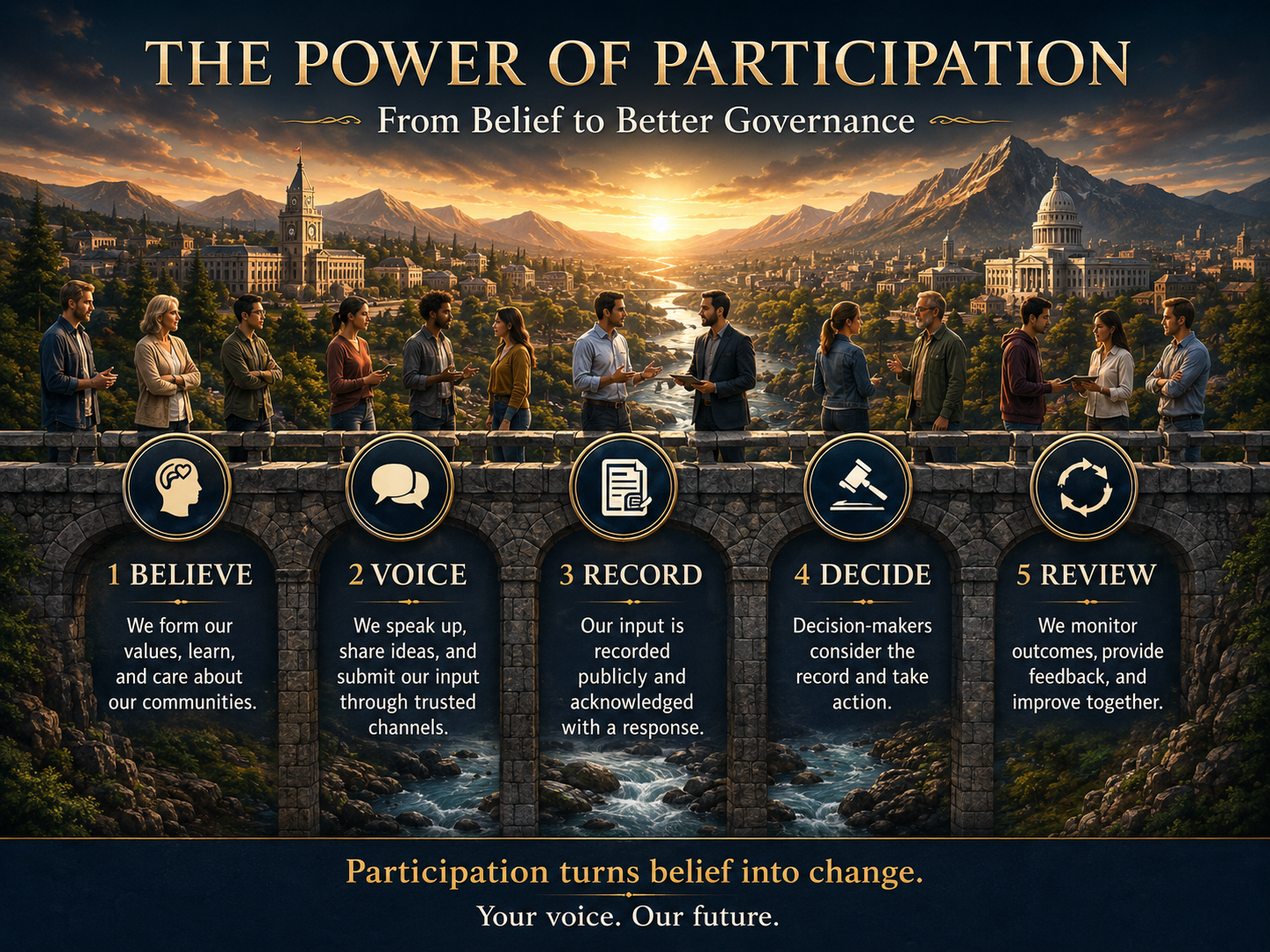
Presence matters, but attendance or visibility alone does not prove influence. Effective voice connects a contribution to a decision owner, lawful standing, a specific request, a durable record, a reasoned response, and continued review or appeal.
This test turns participation from a symbolic ritual into an accountable path. It also exposes participation-washing: consultation that collects labor or legitimacy while leaving every consequential objective, budget, dataset, rule, or release decision closed.
Effective voice
Connect expression to standing, a decision, a record, an answer, and a continuation path.
Participation ledger
Record what was open to change, who participated, what was accepted or rejected, what changed, and how implementation can be reviewed.
Nonparticipation Cedes The Decision
Systems do not pause to interpret absence. Elections are decided by counted ballots. Boards are selected by eligible voters who cast votes. Hiring and policy decisions are made by whoever accepts the role. Search indexes and public datasets reflect material that is actually published and technically discoverable.
| Decision point | Nonparticipation | Registered participation |
|---|---|---|
| Public election | No preference enters the count. | Cast a valid ballot for the candidate, party, independent, third-party option, write-in where countable, or measure that best records the position. |
| Powerful institutional role | Another person occupies the decision point. | Accept the role where it can be exercised lawfully and ethically, publish commitments, build oversight, and redirect policy and resources. |
| Membership organization | Internal elections and bylaws proceed without the dissenting member. | Use lawful membership rights to vote, nominate, propose resolutions, serve on committees, and publish reasons. |
| Religious organization | Policy and teaching develop without an affirming internal voice. | Use congregational, denominational, educational, interfaith, or public-theology channels to challenge anti-LGBTQ bias. |
| Digital public sphere | The view is less likely to enter search, archives, link graphs, and public datasets. | Publish accessible, sourced, durable material with stable links, metadata, licensing, and correction paths. |
Voting As Recorded Protest
Not voting as protest is usually unreadable to the tally. Turnout can be measured, but the deciding process cannot reliably infer each nonvoter’s reason. A valid third-party, independent, write-in, or issue vote enters a formal record and may affect totals, ballot access, funding thresholds, media interpretation, or future coalition strategy. The exact effects vary by jurisdiction and electoral rule.
FFTAC does not endorse a party or candidate. The principle is procedural: use the available voting channel rather than treating absence as a self-explanatory message.
Voting and civic presence
A detailed guide to ballots, third-party and independent voting, public comments, meetings, petitions, and other registered civic channels.
Occupy Decision Points With Accountability
Refusing a powerful job does not remove the office, budget, or authority. It normally leaves the same decision point to another person. Taking the position can create leverage over hiring, procurement, research, data practices, workplace rules, public communication, and resource allocation.
The ethical standard is not to take power at any cost. It is to avoid surrendering a consequential decision point without preserving another effective channel of influence. Responsible internal reform requires declared commitments, conflict controls, independent review, protected dissent, measurable goals, documented decisions, and succession.
Institutional reform from within
How to enter consequential roles without becoming captured by them, and how inside and outside strategies reinforce one another.
Membership Is A Governance Tool
Membership in a flawed organization is not automatic endorsement of every position. Where members elect directors or vote on policy, membership can provide procedural standing that an external critic lacks.
The National Rifle Association is a concrete governance example, not an FFTAC endorsement. Eligible voting members elect directors. A member seeking less partisan, less extreme, or more accountable governance can evaluate candidates, vote, organize, nominate petition candidates where rules permit, propose reforms, and document an internal constituency. External protest, journalism, litigation, and policy advocacy can continue; outside criticism does not substitute for internal voting rights.
Religious And Community Reform
Remaining outside every religious organization removes one possible affirming voice from congregational and denominational decisions. Participation can include joining or remaining in an affirming congregation, voting in assemblies, serving on policy or education committees, supporting LGBTQ clergy and members, funding inclusive programs, documenting discriminatory practices, and building interfaith coalitions.
Participation never requires enduring abuse or surrendering conscience. Safety is preserved through connected alternatives: affirming communities, advocates, legal aid, denominational review, public documentation, and allied institutions. The rule rejects isolation, not safety.
Religious and community reform
Practical channels for changing teaching, budgets, safeguarding rules, leadership, and anti-LGBTQ policy while protecting participants.
Digital Presence Shapes The Machine-Readable Record
Search engines discover public pages through crawling, links, sitemaps, and other signals, but they do not index everything. Public web archives and datasets preserve large portions of the open web, and public web data has been used to develop many language models. This machine-readable record is consequential, but no post is guaranteed to appear in search, an archive, a dataset, or a future model.
The accurate claim is probabilistic: accessible, crawlable, well-linked, well-labeled public material has a greater chance of entering searchable, archivable, and trainable records than a view that is never published. When people disappear from the public record, search systems, researchers, and AI systems see a culture that overrepresents whoever remains visible. Absence can make those systems more like what the absent person objects to.
Digital presence and AI memory
Technical and editorial practices for stable URLs, crawlable links, metadata, transcripts, archives, licensing, provenance, and correction.
Cognitive Liberty Requires Public Presence
Cognitive Liberty protects the freedom to form, question, and revise thought. That freedom remains fragile when the public information environment contains only the views of dominant institutions or the most persistent participants. Diverse public records supply evidence, vocabulary, counterexamples, cultural memory, and models of dissent that other people need in order to think freely.
The Architecture of Defiance is the structure that keeps this participation available: ballots, public comments, membership rights, accountable roles, open publishing, source trails, archives, appeals, interoperable tools, and organizations that can be corrected from within.
Public Belief, False Consensus, And Cultural Memory
Visible speech is social evidence. When people conceal dissent because they expect punishment or isolation, observers can mistake missing speech for agreement. That spiral of silence can produce false consensus, preference falsification, and a public record that overstates support for dominant norms.
A sourced contribution can interrupt the loop by showing that another view exists, supplying language and evidence, creating social proof, and giving people an artifact around which to coordinate. The same networks can also amplify falsehood and harassment, so participation must remain truthful, sourced, privacy-respecting, and correction-ready.
Public belief and discourse
How visible dissent corrects false consensus and becomes coordination, agenda setting, public memory, and future evidence.
Participatory AI Means Governance, Not Data Donation Alone
Public participation in AI can shape problem definition, data stewardship, annotation, post-training preferences, red-team tests, evaluation criteria, deployment conditions, monitoring, and remedies. The power question is concrete: which objective, dataset, benchmark, release condition, procurement rule, or appeal outcome can participants change?
Contributing prompts or data without decision rights can improve a product while leaving authority centralized. FFTAC favors community-governed corpora, public standards, external audits, documented response matrices, continuing oversight, user-controlled portability, and appeal.
Participatory AI governance
A lifecycle framework for public standing in objectives, data, evaluation, deployment, monitoring, and remedy.
Measure The Path From Input To Outcome
Participation should be measured by access, influence, record quality, implementation, outcomes, privacy, and appeal—not merely by attendance, impressions, or the number of comments collected.
A participation ledger makes the path inspectable: mandate, affected people, offered channels, contributions, disagreements, decision owner, response, accepted and rejected changes, implementation evidence, open issues, review date, and privacy protections.
Practice patterns
Concrete replacements for abstention, role refusal, surrendered member votes, community disappearance, and an unpublished digital record.
Sustainable Participation, Not Constant Exposure
Participation is not permanent availability, compulsive posting, unsafe exposure, or heroic exhaustion. Durable participation rotates roles, documents handoffs, protects privacy, schedules rest, and maintains more than one route of influence.
A person may leave an unsafe setting while remaining connected to advocates, peers, public records, legal channels, alternative institutions, and a supported reform network. The replacement for unsafe exposure is supported participation, not disappearance.
Sustainable participation
Boundaries, shared roles, rest, privacy, succession, and multiple channels that preserve influence without isolation.
Resource Links
Links are selected for research value and context. External destinations open in a new tab; archive-only items are intentionally not linked from the public directory.
Public Participation And Digital Record Starting Points
These official references show how ballots, organizational governance, web crawling, and public datasets create legible records. FFTAC does not endorse any candidate, party, or membership organization.